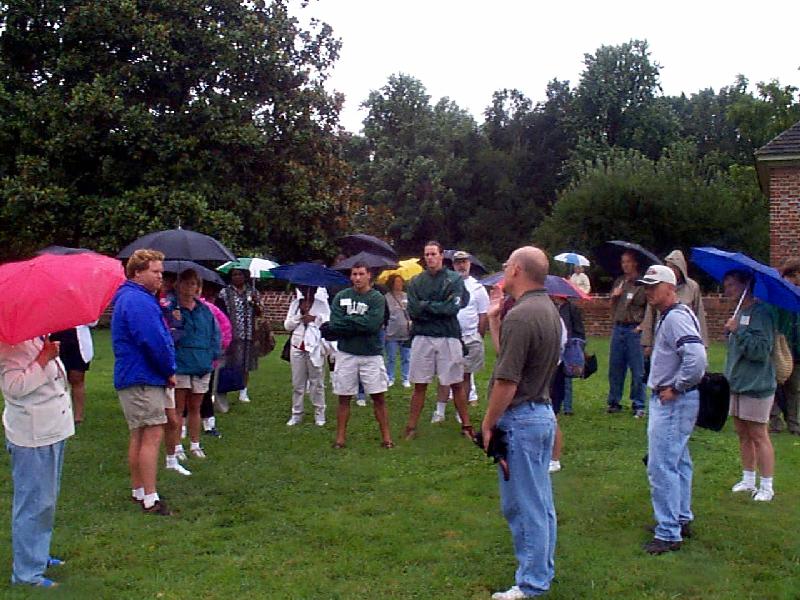
The first stop was the William Wesley Payne Memorial Cabin.
William Payne was the son of a slave on the Stratford plantation who remained
on the plantation until his death in 1954. On a hill overlooking
the Great House and the Potomac River, a cabin was erected to his memory. 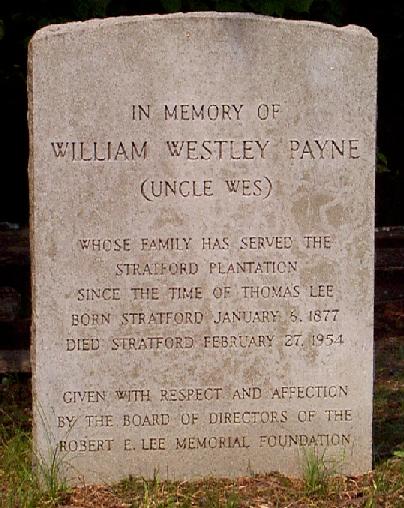 Doug
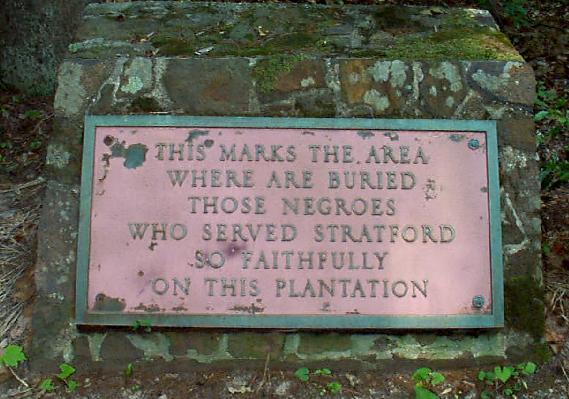
pointed out that the paternalistic wording of the plaque is a sensitive
issue as it perpetuates the faithful servant image. However, the
cabin itself was constructed to honor Mr. Payne's life, and at his request
was designed to replicate the one he was born in. It is also located
in an area that some call "Payne Hill or Knoll" signifying the presence
of the Paynes in that area.
Doug
pointed out that the paternalistic wording of the plaque is a sensitive
issue as it perpetuates the faithful servant image. However, the
cabin itself was constructed to honor Mr. Payne's life, and at his request
was designed to replicate the one he was born in. It is also located
in an area that some call "Payne Hill or Knoll" signifying the presence
of the Paynes in that area.
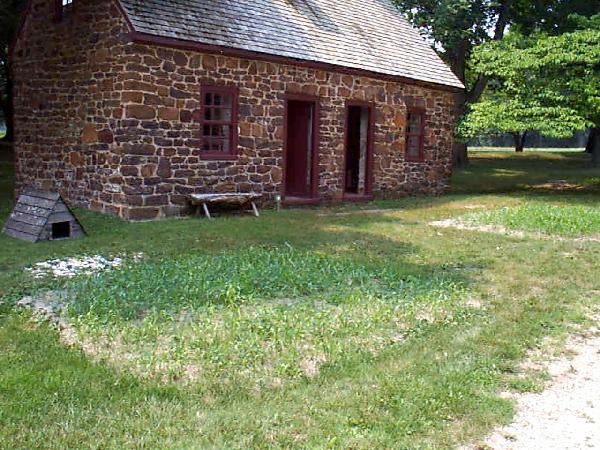 of stone with glass windows and at first glance seem to be out of character
with the type of slave dwellings found elsewhere on the plantation.
The document that provided the guide for the reconstruction at mid -century
was an 1805 insurance sketch that noted the two dwellings were stone.
Doug also commented that the proximity to the Great House made it likely
that they were built to complement the Great House.
of stone with glass windows and at first glance seem to be out of character
with the type of slave dwellings found elsewhere on the plantation.
The document that provided the guide for the reconstruction at mid -century
was an 1805 insurance sketch that noted the two dwellings were stone.
Doug also commented that the proximity to the Great House made it likely
that they were built to complement the Great House.
The site also represented years of frustration as Doug and his crew dug in several locations for the remains of the original quarters in that area. Despite the efforts, no such remains were found, and efforts were abandoned in that location for the present.
 |
 |